Microsoft Outage 2026: Five Cloud Reliability Lessons
Originally published on Naveed Ahmed's Engineering Blog.
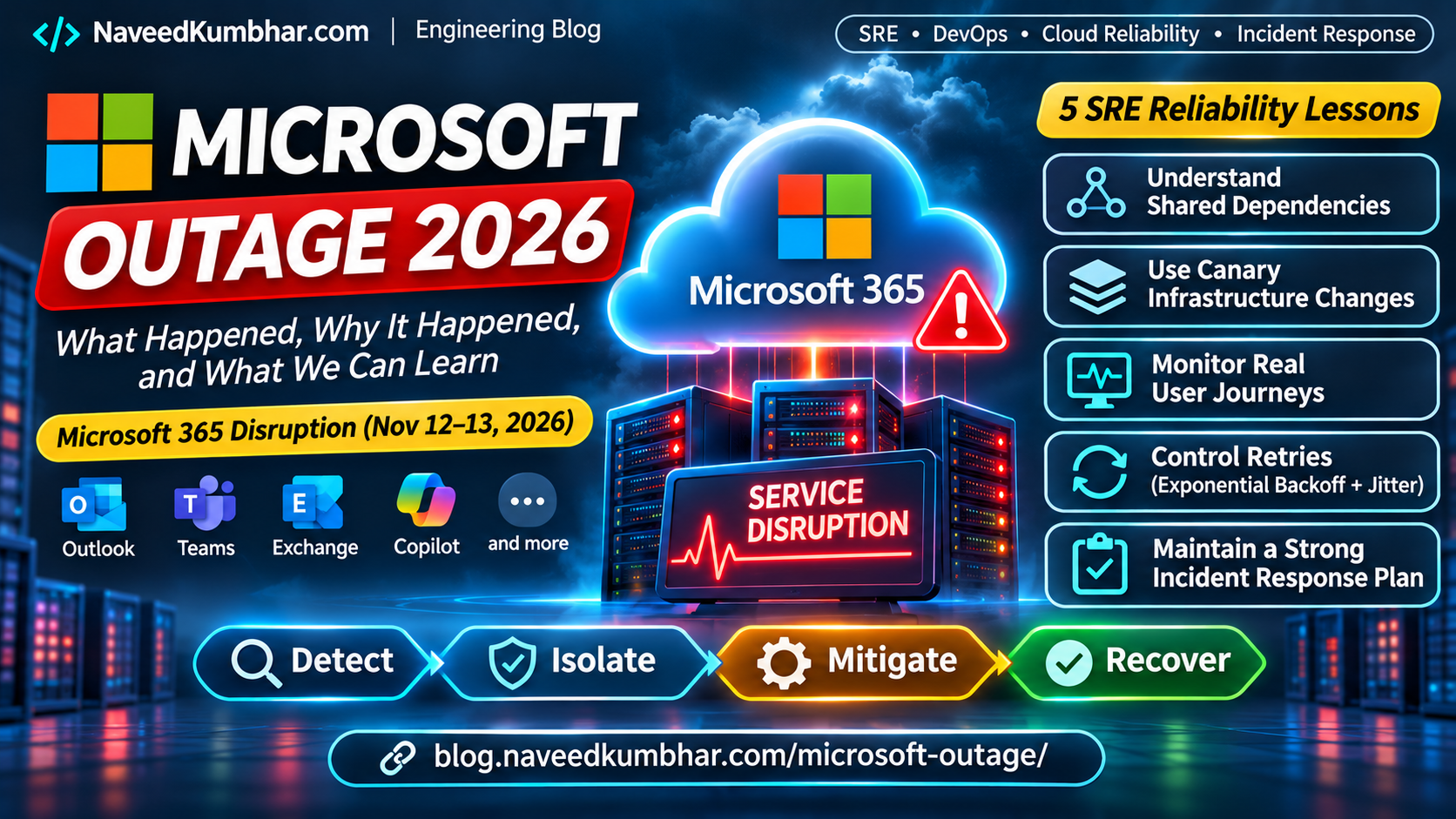
The November 2026 Microsoft 365 outage disrupted services including Outlook, Exchange Online, Copilot, and parts of Teams.
Microsoft reported infrastructure issues following a network-capacity upgrade.
The incident raises an important question for platform engineering teams:
How resilient is an application when its shared dependencies become unavailable?
1. Understand the Dependency Graph
A highly available application can still depend on a single authentication gateway or network control plane.
Map these shared components and consider how their failure affects otherwise healthy services.
2. Treat Infrastructure Changes Like Software Releases
Network, identity, DNS, and routing configuration should be validated and rolled out progressively.
A useful pattern is:
Validate
   ↓
Canary deployment
   ↓
Synthetic health checks
   ↓
Observe
   ↓
Expand or roll back
Don't assume a successful configuration validation proves safe runtime behavior.
3. Monitor End-to-End Functionality
Collect server metrics, but also test important customer journeys.
An application may report healthy processes while actual users cannot authenticate or complete requests.
4. Build Safe Retry Behavior
When a provider begins recovering, synchronized retries can create additional pressure.
Use bounded exponential backoff, jitter, timeouts, and circuit breakers.
Only retry operations when doing so is safe.
5. Prepare for Provider-Level Incidents
Have an independent status and communication plan.
Know where to find official provider advisories, but don't depend solely on a provider's dashboard to understand your own customer impact.
Use synthetic monitoring from independent environments where appropriate.
Read the Full Engineering Guide
The original article examines the Microsoft outage, possible network failure cascades, and practical SRE patterns for safer infrastructure delivery and incident response.
Read Microsoft Outage: Architecture Analysis & SRE Runbook
Precise internal routing events and measurements should be considered unverified until corroborated by a detailed Microsoft postmortem.
Which shared cloud dependency is hardest for your team to recover from?
Written by Naveed Ahmed — DevOps & Platform Engineering
About the author
- Senior DevOps, Cloud & Site Reliability Engineer at DigitalOcean. I write about modern container orchestration, Linux systems, and cloud-native architecture. Explore my guides, architectures, and portfolio: • Website: https://naveedkumbhar.com • Resume: https://cv.naveedkumbhar.com • Blog: https://blog.naveedkumbhar.com • Newsletter: https://news.naveedkumbhar.com
Comments
Join the discussionNo comments yet. Be the first to comment.