The Modern Software Engineer: From DevOps to Platform Engineering
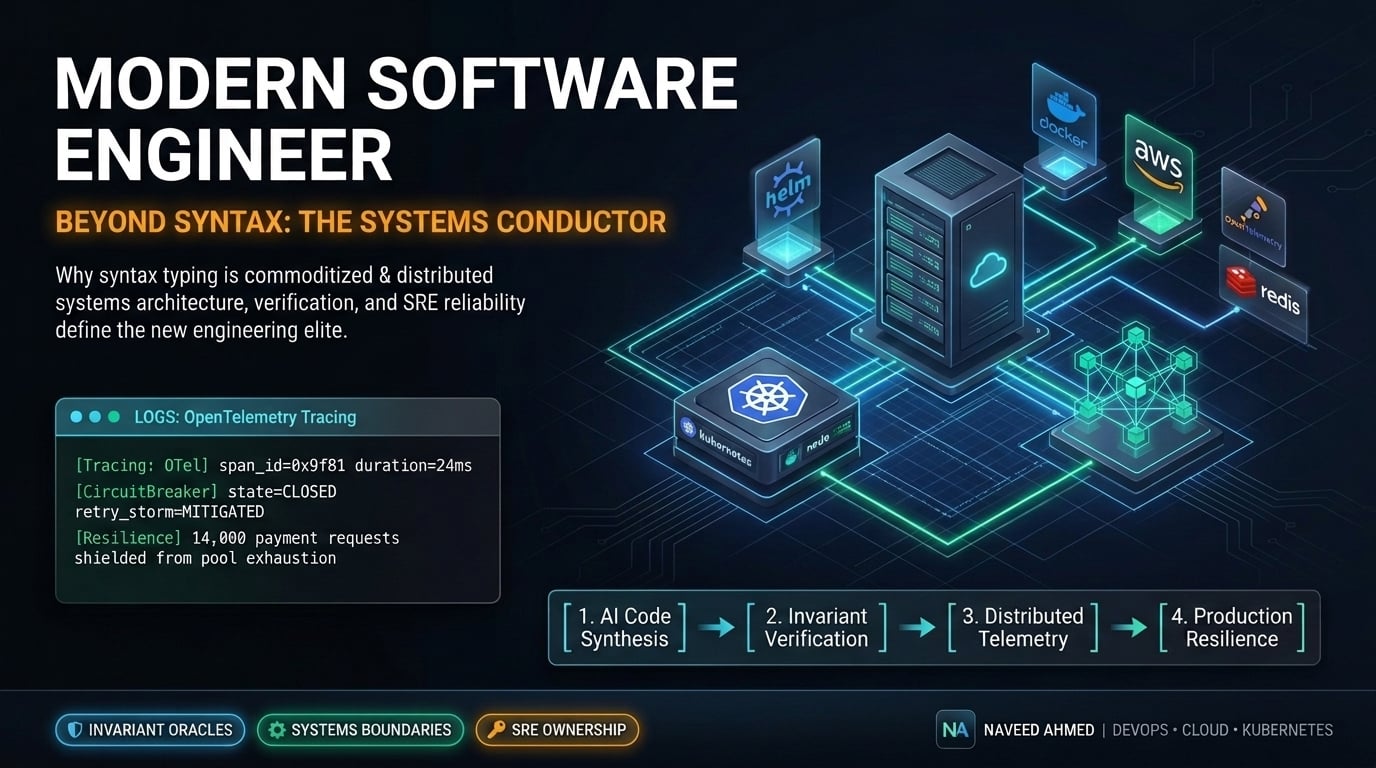
Why traditional DevOps silos became bottlenecks, how Platform Engineering simplifies cloud-native delivery, and why AI cannot replace architectural judgment.
Every few years, the technology industry announces the death of another engineering discipline.
"Serverless killed operations."
"GitOps replaced CI/CD."
"AI is replacing DevOps engineers."
But production tells a different story.
DevOps isn't dead. What's failing is the traditional model of treating DevOps as a separate, ticket-driven department.
Modern software engineering is evolving beyond writing code and managing infrastructure. The real value increasingly comes from designing reliable systems, building developer platforms, and reducing operational complexity.
1. Why Traditional DevOps Teams Became Bottlenecks
DevOps was introduced to improve collaboration between development and operations.
However, many organizations implemented it by creating a separate team responsible for deployments, CI/CD pipelines, Kubernetes clusters, and cloud infrastructure.
The result?
Developers still opened Jira tickets and waited for another team to provision resources or deploy applications.
The bottleneck remained. Only the department name changed.
DevOps is a culture of shared responsibility, not simply a job title or an isolated engineering team.
2. Platform Engineering: The Shift Toward Self-Service
Platform Engineering addresses this challenge through Internal Developer Platforms (IDPs) and standardized workflows called Golden Paths.
Instead of requiring developers to understand every infrastructure component, platform teams provide secure, reusable deployment capabilities.
Consider this difference:
Traditional workflow:
Developer → Jira Ticket → DevOps Team → Infrastructure → Deployment
Platform Engineering workflow:
Developer → Self-Service Platform → Automated Infrastructure → Deployment
Tools such as Backstage, Crossplane, Terraform, and Argo CD can help implement these capabilities.
The objective isn't to eliminate infrastructure complexity.
It's to make secure, reliable, and observable deployment workflows easier for developers to use.
3. Modern Engineers Need Systems Thinking
Writing application code is only one part of modern engineering.
Production environments involve interconnected systems:
Kubernetes orchestration and scheduling
Cloud networking and security
Infrastructure as Code and GitOps
Distributed databases and messaging
Monitoring, observability, and incident response
Reliability, scalability, and disaster recovery
When something breaks, understanding the relationships between these components is often more valuable than knowing individual commands.
Modern engineering is shifting from managing isolated tools to understanding complete systems.
4. AI Cannot Replace the 3 AM Incident Response
AI is becoming useful for generating configurations, analyzing logs, identifying patterns, and automating repetitive engineering tasks.
But consider a critical Kubernetes production incident involving an unavailable API server, networking failures, or an overloaded control plane.
AI may propose commands and recovery procedures.
However, someone must still evaluate:
Whether the suggested fix is safe
Its potential impact on production workloads
The possibility of data loss
Recovery priorities and rollback strategies
AI accelerates troubleshooting, but experienced engineers remain responsible for high-impact production decisions.
The future is not simply AI replacing DevOps.
It's engineers building reliable platforms and using AI within controlled automation workflows.
5. What Should Modern Software Engineers Learn?
Five areas are becoming increasingly important:
Systems Architecture: Distributed systems, networking, scalability, and reliability.
Cloud-Native Engineering: Kubernetes, containers, Terraform, and GitOps.
Platform Engineering: Internal Developer Platforms, Golden Paths, and developer self-service.
Site Reliability Engineering: Observability, incident response, SLOs, and production operations.
AI-Assisted Operations: Automation, intelligent troubleshooting, and human-controlled decision-making.
The goal isn't to learn every available tool.
It's to develop the architectural judgment required to build and operate dependable production systems.
Read the Complete Technical Deep Dive
This article is a condensed overview of my original technical guide.
The full article explores:
Why the traditional DevOps team model often fails
Platform Engineering architecture and Golden Paths
Internal Developer Platforms and developer experience
Crossplane and Argo CD implementation concepts
Kubernetes and distributed systems challenges
AI-assisted operations and production incident response
Practical examples, configurations, and architecture diagrams
👉 Read the Full 14-Minute Architectural Guide: The Modern Software Engineer Role
Original article: https://blog.naveedkumbhar.com/modern-software-engineer-role/
About Naveed Ahmed
I'm Naveed Ahmed, a DevOps and Platform Engineering professional sharing practical knowledge about cloud infrastructure, Kubernetes, automation, system architecture, and production reliability.
Explore my engineering ecosystem:
Learn. Build. Automate. Scale.
Originally published on the Naveed Ahmed Engineering Blog on October 5, 2026.
About the author
- Senior DevOps, Cloud & Site Reliability Engineer at DigitalOcean. I write about modern container orchestration, Linux systems, and cloud-native architecture. Explore my guides, architectures, and portfolio: • Website: https://naveedkumbhar.com • Resume: https://cv.naveedkumbhar.com • Blog: https://blog.naveedkumbhar.com • Newsletter: https://news.naveedkumbhar.com
Comments
Join the discussionNo comments yet. Be the first to comment.