AI Agent Guardrails: Building Secure, Cost-Aware Autonomous Systems
Originally published on Naveed Ahmed's Engineering Blog.
An AI agent that can answer questions is one thing.
An AI agent that can execute shell commands, provision cloud resources, and change production infrastructure is something very different.
Once an agent has real-world capabilities, you need enforceable limits around what it can do.
Here's how I'd approach production guardrails.
1. Understand the Risk
Suppose an AI agent is troubleshooting a failed deployment.
It encounters an error and retries the same operation repeatedly.
Without execution limits, the workflow might generate unnecessary API requests, consume tokens, or create unexpected infrastructure costs.
A system prompt can discourage that behavior, but it doesn't guarantee that the agent will stop.
The execution layer must enforce the limit.
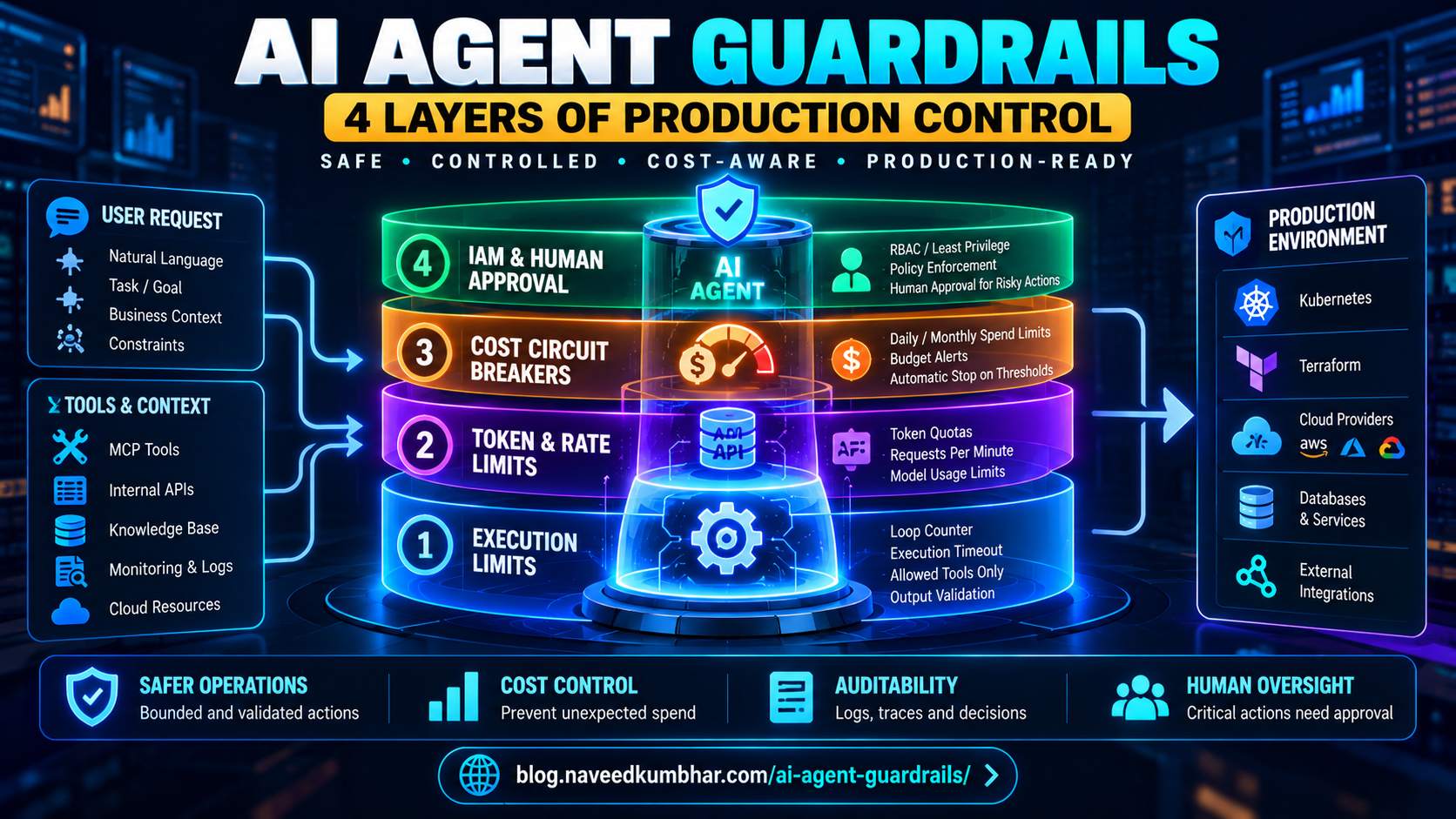
2. Four Layers of Guardrails
A practical architecture includes four types of controls.
Execution Limits: Maximum tool calls, retry limits, recursion depth, and timeouts.
Token and API Quotas: Per-agent token budgets, request-rate limits, and concurrency controls.
Financial Circuit Breakers: Cost tracking, application-level spending limits, and cloud budget notifications.
IAM and Human Approval: Least-privilege permissions, separated read/write capabilities, and approval requirements for high-risk operations.
Each layer addresses a different risk.
3. Python Execution Guardrail
Here's a simple example:
from time import monotonic

class ToolBudget:
    def __init__(self, max_calls=10, seconds=60):
        self.remaining = max_calls
        self.deadline = monotonic() + seconds

    def check(self):
        if monotonic() >= self.deadline:
            raise RuntimeError("Execution timed out")

        if self.remaining <= 0:
            raise RuntimeError("Tool budget exhausted")

        self.remaining -= 1
Call check() before executing an approved tool.
In production, you'd also need concurrency-safe shared counters, cost accounting, permission checks, and persistent audit records.
4. Control Cloud Costs
For agents operating across AWS, GCP, or Azure, cloud billing alerts provide useful visibility.
But alerts aren't the same as hard spending limits.
For immediate enforcement, check tool budgets before actions that incur costs.
For example, a resource-provisioning tool might reject requests once an approved task budget or resource quota is exhausted.
Cloud billing notifications can then provide another layer of monitoring and remediation.
5. Security and Approval
Use separate credentials for diagnostic and write-capable operations.
Give agents only the resources and actions required for each task.
For high-impact operations, require explicit human authorization before the execution service proceeds.
The agent should not be able to override these restrictions through prompts or tool arguments.
Read the Full Technical Guide
My complete tutorial explores:
- Four-tier guardrail architecture
- Tool execution limits
- Token and rate quotas
- AWS, GCP, and Azure financial controls
- Python circuit breakers
- IAM security and human approval
- Production governance
Read AI Agent Guardrails: Full Production Guide
Final Thoughts
The important question isn't whether an AI agent can execute a task.
It's whether the system can reliably prevent unauthorized, excessive, or unsafe execution.
Which agent guardrails are you already using in production?
Written by Naveed Ahmed — Lead DevOps & Platform Architect
About the author
- Senior DevOps, Cloud & Site Reliability Engineer at DigitalOcean. I write about modern container orchestration, Linux systems, and cloud-native architecture. Explore my guides, architectures, and portfolio: • Website: https://naveedkumbhar.com • Resume: https://cv.naveedkumbhar.com • Blog: https://blog.naveedkumbhar.com • Newsletter: https://news.naveedkumbhar.com
Comments
Join the discussionNo comments yet. Be the first to comment.