Argo Rollouts: A Practical Approach to Safer Kubernetes Releases
Originally published on Naveed Ahmed's Engineering Blog.
One of the more frustrating production problems is a deployment that looks healthy at the infrastructure level but causes application errors.
The Pods are running. Readiness passes. Kubernetes continues replacing old replicas.
Yet customers see a regression.
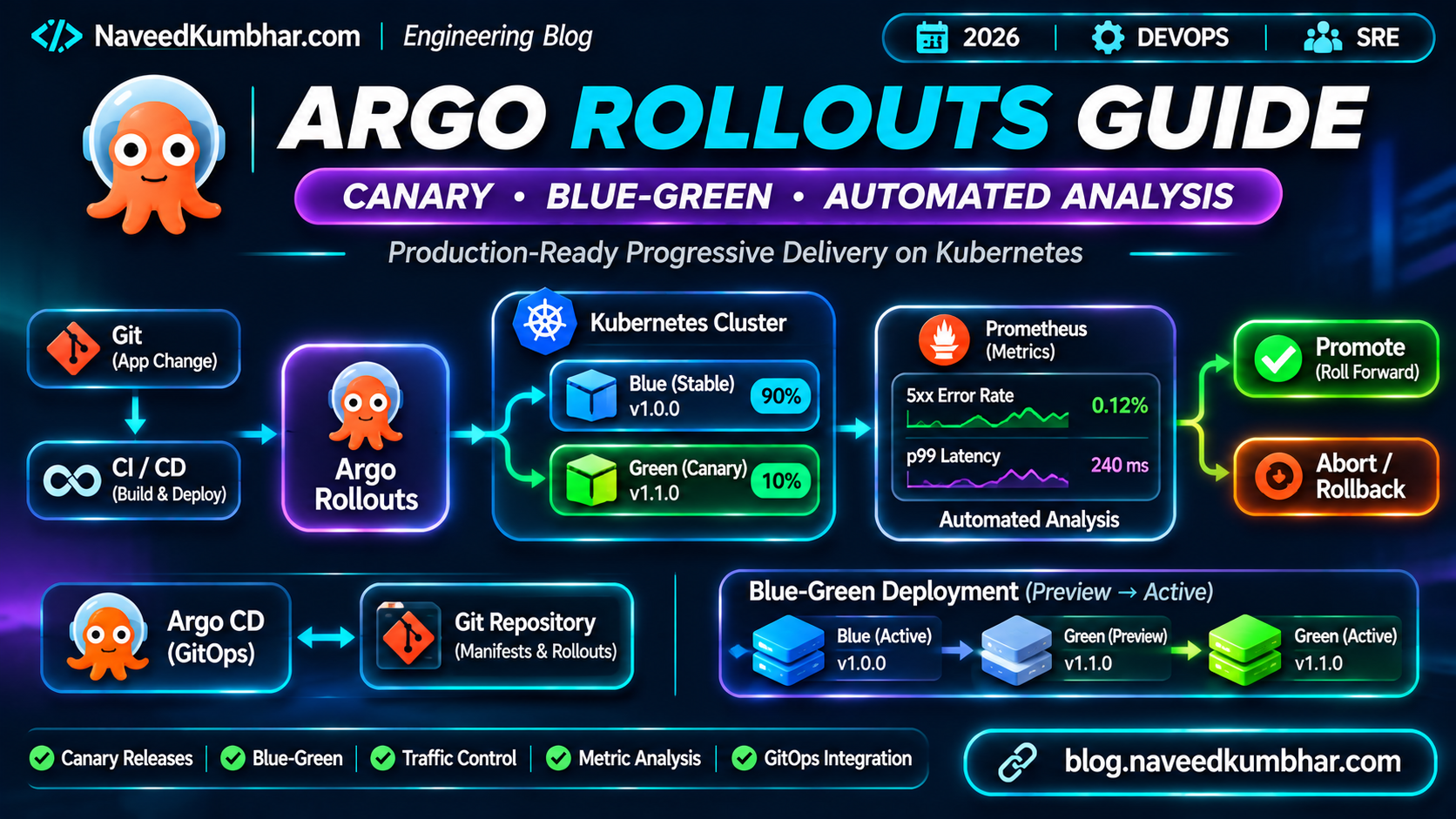
Argo Rollouts helps address this by adding controlled release stages and metric-based verification.
Canary Deployments
A canary exposes a smaller audience to the new version first.
For example, you might begin at 10%, observe error rates and latency, then gradually increase exposure.
Fine-grained percentages require integration with a compatible traffic router.
Without one, Rollouts approximates the distribution through ReplicaSet sizes.
Blue-Green Deployments
A blue-green strategy maintains an active version and a preview version.
The team can test the new release before switching the production Service.
This approach is useful when you want to validate a complete replacement environment before traffic cutover.
However, database changes and other external side effects still require independent recovery planning.
Automated Analysis
The most interesting part for SRE teams is the AnalysisTemplate.
It allows a rollout to evaluate metrics such as:
- HTTP error rates
- P95 or P99 latency
- Request success rates
- Application-specific failure signals
Prometheus and Datadog are among the supported providers.
The metric query matters just as much as the threshold.
A low-traffic canary might not produce enough observations for a meaningful decision.
Working With Argo CD
Argo CD and Argo Rollouts complement one another.
Argo CD keeps the desired manifests synchronized from Git.
Argo Rollouts manages the release progression and traffic shifts.
You'll need to account for fields that the Rollouts controller or traffic integration changes dynamically so Argo CD doesn't attempt to reverse legitimate rollout behavior.
Production Troubleshooting
If a release is stuck, start with the Rollout and AnalysisRun states.
kubectl argo rollouts get rollout checkout-api \
  -n prod --watch
kubectl get analysisruns -n prod
kubectl get events -n prod
Check whether the rollout is awaiting a manual pause, the metric query is returning valid results, or a routing integration is failing.
Avoid forcing promotion simply to clear an alert.
Read the Complete Guide
My original article goes deeper into the Helm installation, traffic-routing configuration, canary and blue-green manifests, Prometheus queries, and operational troubleshooting.
Read Argo Rollouts: Production Progressive Delivery Guide
What's your most important production deployment health signal?
Written by Naveed Ahmed — DevOps & Platform Engineering
About the author
- Senior DevOps, Cloud & Site Reliability Engineer at DigitalOcean. I write about modern container orchestration, Linux systems, and cloud-native architecture. Explore my guides, architectures, and portfolio: • Website: https://naveedkumbhar.com • Resume: https://cv.naveedkumbhar.com • Blog: https://blog.naveedkumbhar.com • Newsletter: https://news.naveedkumbhar.com
Comments
Join the discussionNo comments yet. Be the first to comment.