NFS2ROOT: How to Assess Linux NFS Servers Before They Become an Incident
Originally published on Naveed Ahmed's Engineering Blog.
When we talk about critical infrastructure vulnerabilities, we often focus on web servers, application frameworks, and public APIs.
Storage infrastructure deserves the same attention.
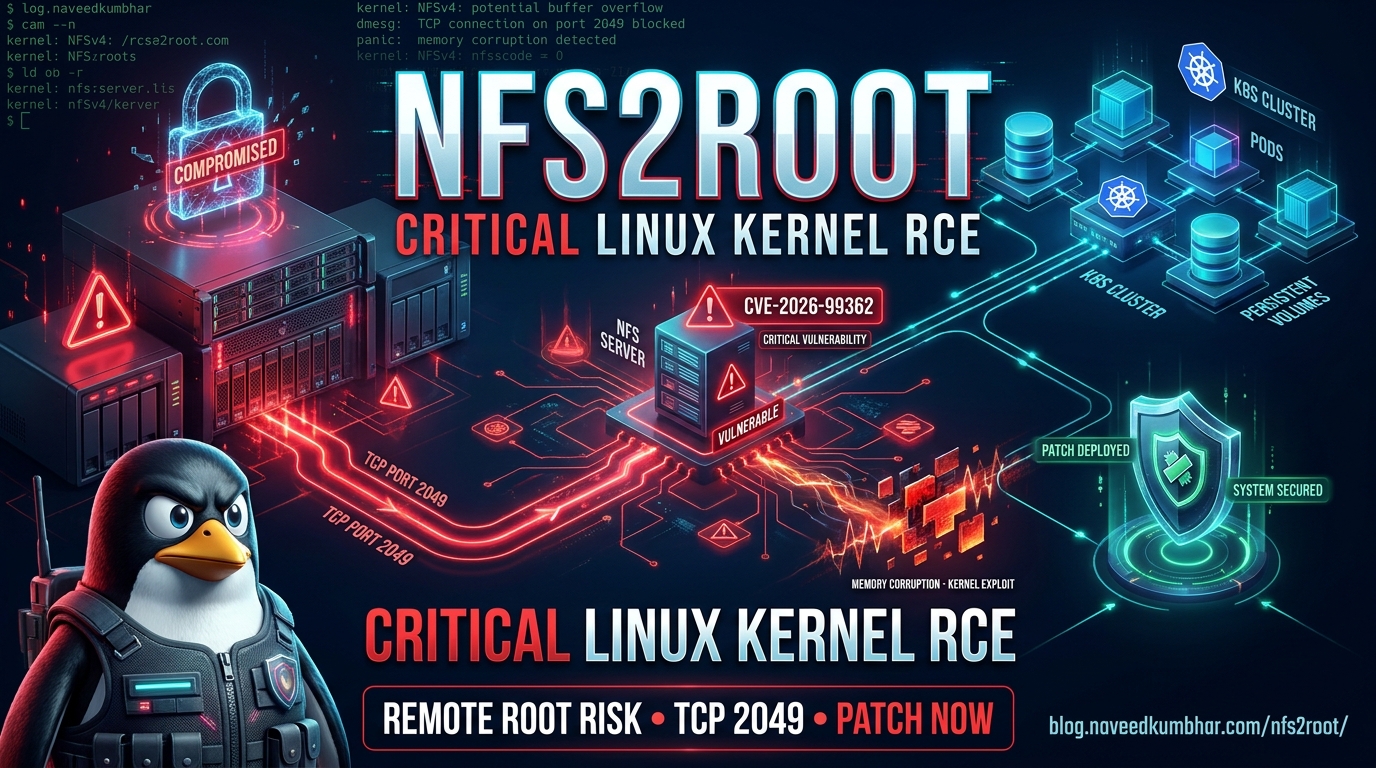
NFS2ROOT, tracked as CVE-2026-99362, affects the Linux kernel's NFS server.
The vulnerability involves a memory-safety issue in NFSv4.1 and NFSv4.2 request processing.
Researchers demonstrated a chain leading to remote root execution.
Start With the Exposure Conditions
A vulnerable system needs more than the presence of NFS packages.
The relevant conditions include an affected kernel, active kernel NFS server functionality, relevant NFS protocol versions, and network reachability.
An NFS client mounting a share is not automatically equivalent to a vulnerable NFS server.
Audit the Host
Start with:
uname -r
Check for a listening NFS service:
sudo ss -ltnp 'sport = :2049'
Review active protocol versions:
cat /proc/fs/nfsd/versions
Then confirm the actual kernel patch status against your Linux distribution's advisory.
Don't Forget NAS and Kubernetes Storage
Some of the most important NFS servers aren't general-purpose application hosts.
They may be storage appliances, dedicated file servers, backup systems, or services supporting Kubernetes PersistentVolumes.
Identify the NFS server endpoint and its owner.
For Kubernetes, distinguish the NFS server from the nodes that only mount its shares.
Fixing the Vulnerability
Apply the vendor's patched kernel and reboot to activate the fix.
Where immediate patching is impossible, restrict NFS network access to trusted clients.
Consider disabling unused NFS functionality when doing so won't interrupt workloads.
Validate Recovery
After maintenance:
- Confirm the patched kernel is running.
- Validate NFS service and exports.
- Check authorized client mounts.
- Test affected application workloads.
- Review logs for unexpected kernel or storage errors.
Security patching isn't finished until the system has returned to a verified working state.
Complete NFS2ROOT Guide
My original article contains a more detailed technical explanation, kernel patch matrix, Linux and NAS audit commands, Kubernetes storage considerations, and incident-response checklist.
Read NFS2ROOT: CVE-2026-99362 Technical Guide
Which storage infrastructure component is hardest for your team to update safely?
Written by Naveed Ahmed — DevOps & Platform Engineering
About the author
- Senior DevOps, Cloud & Site Reliability Engineer at DigitalOcean. I write about modern container orchestration, Linux systems, and cloud-native architecture. Explore my guides, architectures, and portfolio: • Website: https://naveedkumbhar.com • Resume: https://cv.naveedkumbhar.com • Blog: https://blog.naveedkumbhar.com • Newsletter: https://news.naveedkumbhar.com
Comments
Join the discussionNo comments yet. Be the first to comment.