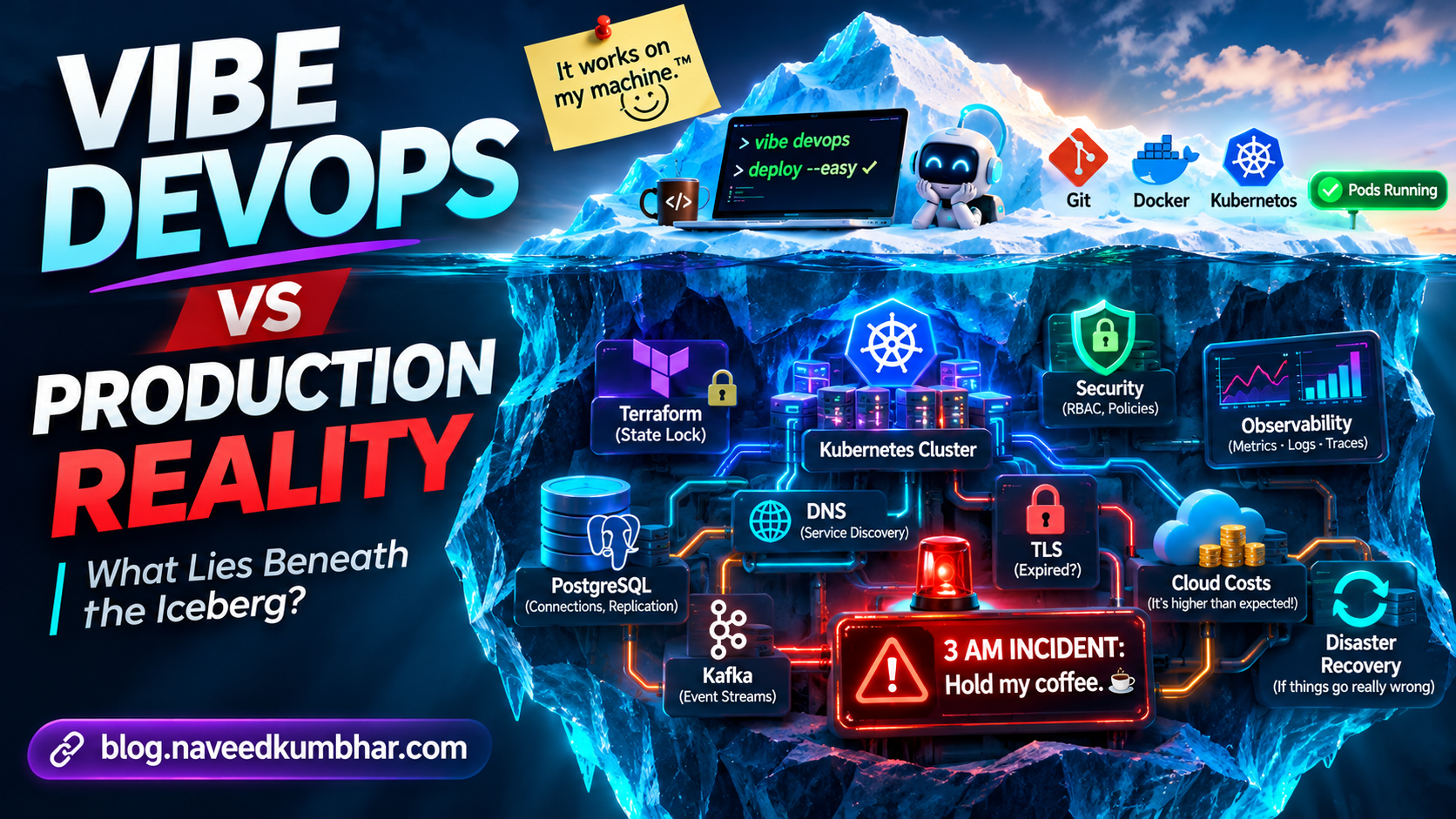
Vibe DevOps vs Real DevOps: What Lies Beneath the Iceberg?
Originally published on Naveed Ahmed's Engineering Blog.
Learning Docker, Git, Terraform, and Kubernetes is an important start.
The problem begins when we mistake knowing those tools for knowing how to operate a production platform.
That's what my new article calls Vibe DevOps.
The Surface Looks Easy
In a tutorial, every component behaves.
The Docker image builds.
The Kubernetes Pod starts.
The Terraform plan applies to an empty account.
The monitoring dashboard loads.
There's no historical infrastructure, no unexpected traffic, no expiring internal certificates, and no real customer impact.
Production adds all of those things.
What Lies Under the Waterline?
The article organizes the complexity into deeper layers.
Delivery and Infrastructure as Code
Remote Terraform state, drift detection, multi-team deployments, CI/CD approvals, GitOps reconciliation, and safe rollbacks.
Networking and Security
DNS, ingress controllers, cloud networking, TLS, IAM, RBAC, secrets, and supply-chain controls.
Observability
Metrics, useful alerts, structured logging, distributed tracing, and SLOs.
Data and Reliability
PostgreSQL connection pools, Kafka consumer lag, persistence, backups, and recovery.
Scaling and Cost
HPA, Karpenter, capacity limits, disaster recovery planning, and FinOps.
When Kubernetes Says Everything Is Fine
A useful example is an application whose Pods remain healthy while customer requests fail.
A simple readiness probe confirms that the process can accept traffic.
It doesn't necessarily verify that downstream database operations complete successfully.
This is where symptom-oriented monitoring matters.
You need to understand application error rates, latency, connection utilization, and dependency failures.
Why AI Changes the Workflow, Not the Responsibility
AI-assisted infrastructure generation can be a productivity boost.
It can draft a Dockerfile, suggest a Terraform module, or explain why a Pod is stuck.
But generated infrastructure must still pass security policy, review, testing, and production-readiness checks.
The output isn't trustworthy simply because it parses successfully.
Build Operational Depth
Rather than memorize more commands, practice failure scenarios.
Trace requests from browser to Pod.
Investigate DNS resolution.
Review a Terraform plan for unexpected replacements.
Test a backup restore.
Study how a Kubernetes node failure affects running workloads.
Those exercises develop the skills that production environments require.
Read the Complete Article
The full guide includes the DevOps iceberg, three illustrative production incidents, an audit checklist, and a 30-60-90-day learning roadmap.
Read Vibe DevOps vs Production Reality
Which part of the DevOps iceberg took you longest to understand?
Written by Naveed Ahmed — DevOps & Platform Engineering
About the author
- Senior DevOps, Cloud & Site Reliability Engineer at DigitalOcean. I write about modern container orchestration, Linux systems, and cloud-native architecture. Explore my guides, architectures, and portfolio: • Website: https://naveedkumbhar.com • Resume: https://cv.naveedkumbhar.com • Blog: https://blog.naveedkumbhar.com • Newsletter: https://news.naveedkumbhar.com
Comments
Join the discussionNo comments yet. Be the first to comment.