KEDA vs HPA vs Karpenter: Understanding Kubernetes Autoscaling
Originally published on Naveed Ahmed's Engineering Blog.
Kubernetes autoscaling gets more interesting when the workload doesn't follow CPU usage.
A web API might scale well using resource metrics.
But a queue consumer can have low CPU usage while the number of unprocessed messages grows quickly.
This is where event-driven autoscaling can be useful.
What KEDA Adds
KEDA stands for Kubernetes Event-Driven Autoscaling.
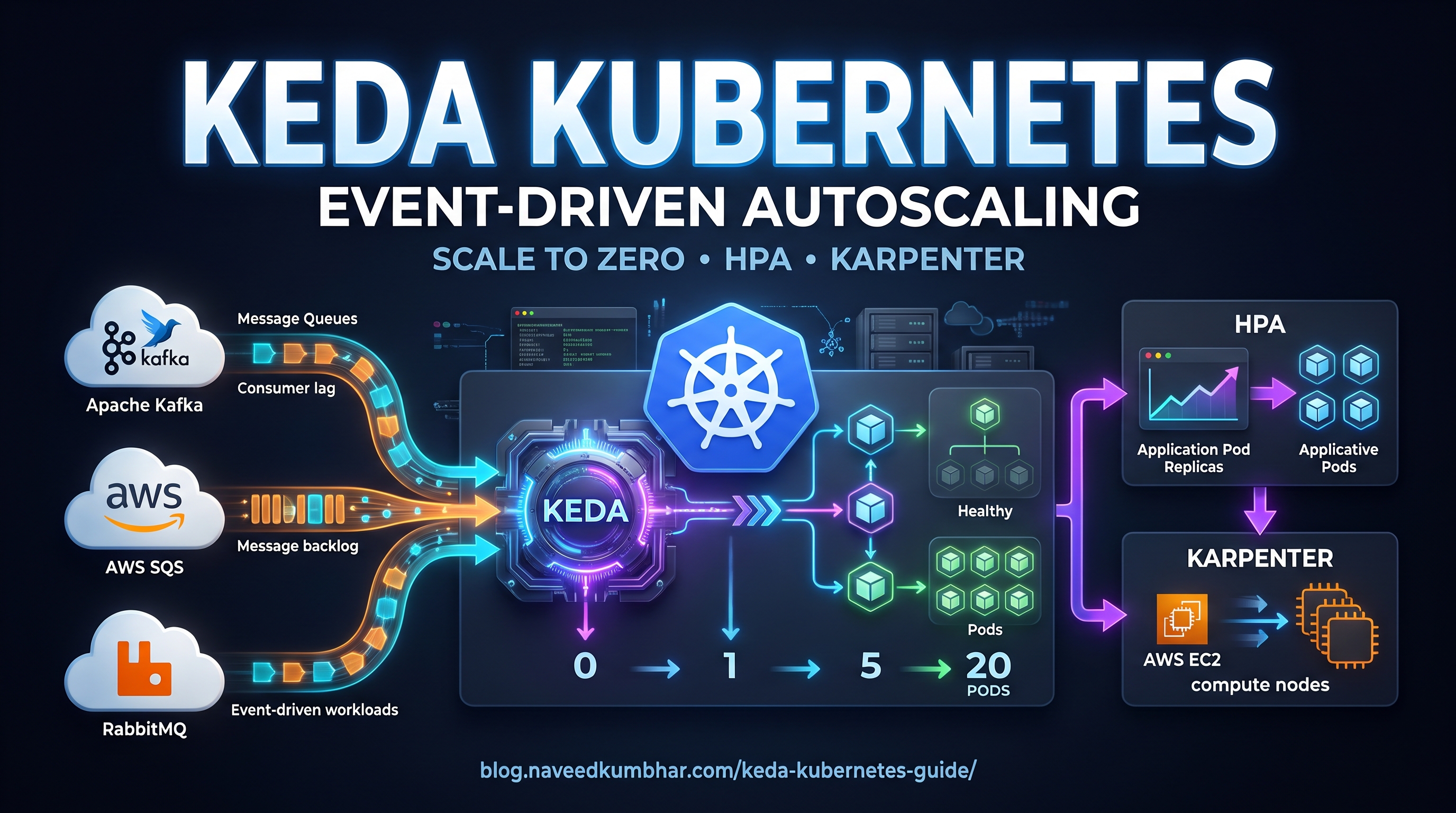
It connects workloads to external signals such as SQS, Kafka, RabbitMQ and Prometheus.
For a Deployment controlled by a ScaledObject, KEDA can activate workers from zero and provide metrics to the native Kubernetes HPA for further scale-out.
How It Differs From HPA
HPA already supports CPU, memory and other metrics through suitable adapters.
KEDA's value is its ready-made event-source integrations and activation behavior.
It's particularly helpful for asynchronous services.
Examples include image-processing workers, message consumers, background jobs and scheduled workloads.
Where Karpenter Fits
KEDA controls application replicas.
Karpenter controls cluster node capacity on supported AWS environments.
A queue burst may cause KEDA to increase replicas, but if the nodes are full, those Pods can remain Pending.
Karpenter can then provision suitable capacity.
Both layers need appropriate limits and permissions.
Why Scale-to-Zero Needs Testing
Zero replicas can reduce idle compute usage.
But new traffic needs time to activate and initialize the application.
Measure your real cold-start time.
For latency-sensitive workloads, a minimum replica count may be the better choice.
Common Troubleshooting Questions
If KEDA isn't scaling, check:
- Whether the
ScaledObjectis healthy - Whether the external trigger is active
- Whether authentication succeeds
- Whether the metrics API is available
- Whether a conflicting HPA exists
- Whether Pods are Pending because of cluster capacity
These checks help separate an event-scaling problem from a Kubernetes scheduling problem.
Read the Complete Guide
My original article includes Helm installation, AKS integration, AWS SQS manifests, predictive scaling, a KEDA compatibility discussion and practical troubleshooting.
Read KEDA Kubernetes: Complete Event-Driven Autoscaling Guide
Which workload would you scale using external events instead of CPU?
Written by Naveed Ahmed — DevOps & Platform Engineering
About the author
- Senior DevOps, Cloud & Site Reliability Engineer at DigitalOcean. I write about modern container orchestration, Linux systems, and cloud-native architecture. Explore my guides, architectures, and portfolio: • Website: https://naveedkumbhar.com • Resume: https://cv.naveedkumbhar.com • Blog: https://blog.naveedkumbhar.com • Newsletter: https://news.naveedkumbhar.com
Comments
Join the discussionNo comments yet. Be the first to comment.