Ruby Deserialization Security: Kubernetes Auditing & Production Hardening
Originally published on Naveed Ahmed's Engineering Blog.
One overlooked data-processing decision can create a serious application security problem.
In Ruby, object deserialization is a good example.
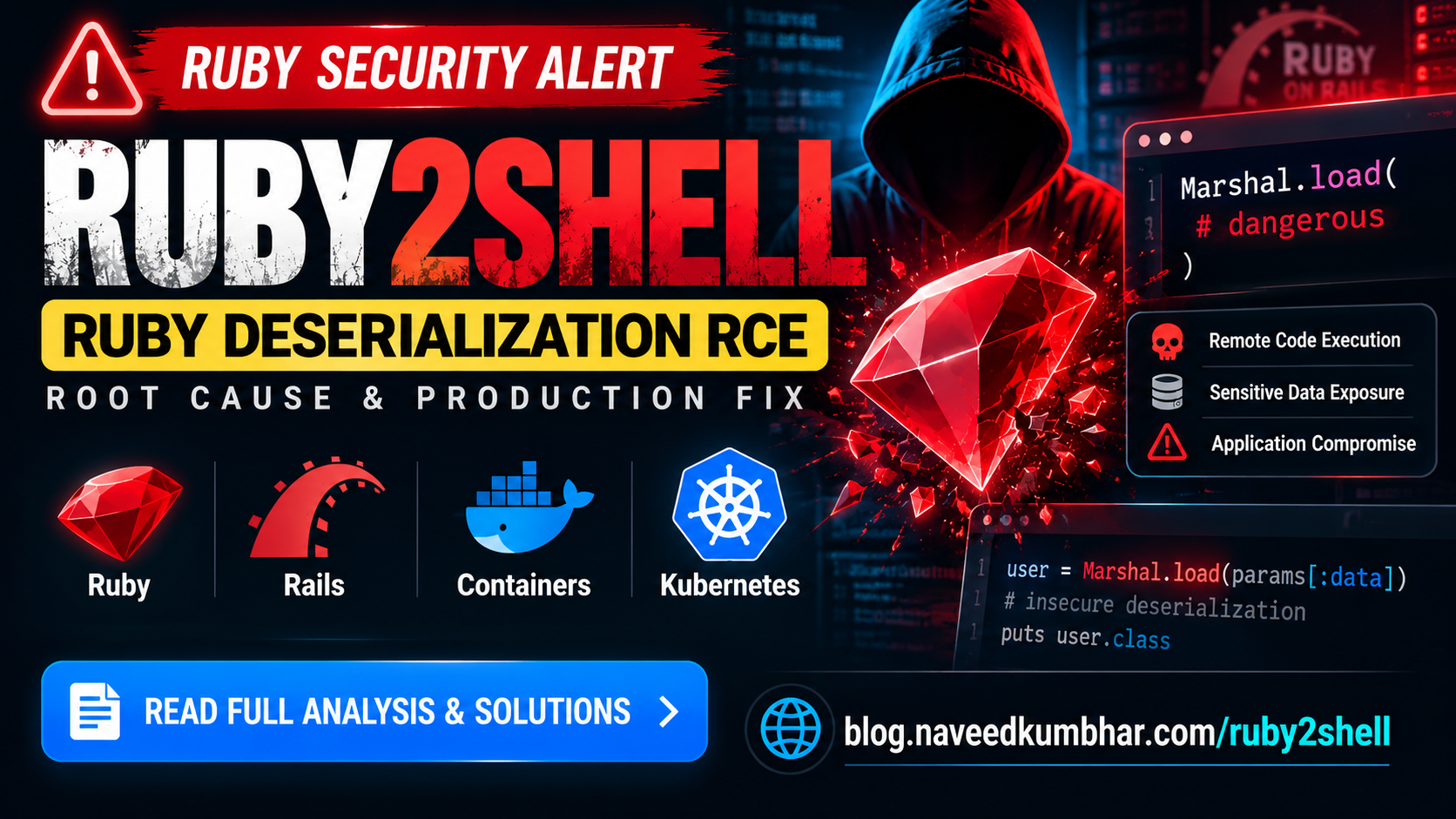
The Marshal module can reconstruct Ruby objects from serialized data. But allowing untrusted input into that process can introduce dangerous behavior.
For engineers managing Ruby applications in Kubernetes, securing the application means understanding both the code and the runtime environment.
1. Understanding Ruby Deserialization Risks
Ruby provides the Marshal.load method to reconstruct serialized objects.
For trusted data, this is useful.
But untrusted serialized input should not be passed directly to this method.
Potential risks depend on the application and the types of objects involved.
The safest approach is to avoid native object deserialization for external input wherever possible.
2. Find Unsafe Deserialization Paths
Start by examining application code:
grep -RInE 'Marshal\.(load|restore)' \
  --include='*.rb' app lib
Review the results carefully.
Ask whether the serialized data originates from trusted internal operations or can be influenced by users or external services.
Also inspect background jobs, cache integrations, and session handling.
3. Audit Kubernetes Workloads
List Ruby application images:
kubectl get pods -n production \
  -o custom-columns='POD:.metadata.name,IMAGES:.spec.containers[*].image'
Inspect the runtime version:
kubectl exec -n production deploy/rails-api \
  -c web -- ruby -v
These commands help identify running software for further assessment.
4. Scan Container Images
Use Trivy to scan for known vulnerabilities:
trivy image --scanners vuln \
  --severity HIGH,CRITICAL \
  registry.example.com/rails-api:production
Use SBOMs where possible to improve dependency tracking.
Remember that a vulnerability scan doesn't automatically detect unsafe application logic.
5. Harden Production Applications
A practical security strategy includes:
- Avoiding unsafe deserialization of untrusted data
- Using suitable formats and strict input validation
- Updating Ruby and application dependencies
- Rebuilding container images
- Running workloads with limited privileges
- Restricting unnecessary network access
- Monitoring errors and abnormal application behavior
These controls are valuable even when no specific runtime CVE applies.
Read the Full Ruby Security Guide
I wrote a longer article discussing Ruby2Shell claims, Ruby deserialization security, Kubernetes investigation, and production hardening.
Read the Complete Ruby2Shell Technical Guide
The article's specific CVE-2026-113840 claims require confirmation from an official security advisory.
Final Thoughts
Application security isn't just about patching packages.
It's also about understanding how your software handles data, where that data comes from, and what privileges the application has.
Does your team include unsafe deserialization checks in its DevSecOps pipeline?
I'd be interested to hear your approach.
Written by Naveed Ahmed — Lead DevOps & Platform Architect
About the author
- Senior DevOps, Cloud & Site Reliability Engineer at DigitalOcean. I write about modern container orchestration, Linux systems, and cloud-native architecture. Explore my guides, architectures, and portfolio: • Website: https://naveedkumbhar.com • Resume: https://cv.naveedkumbhar.com • Blog: https://blog.naveedkumbhar.com • Newsletter: https://news.naveedkumbhar.com
Comments
Join the discussionNo comments yet. Be the first to comment.