Caddy vs NGINX vs Traefik: Choosing a Reverse Proxy in 2026
Originally published on Naveed Ahmed's Engineering Blog.
A reverse proxy is one of those infrastructure components that seems simple until you're responsible for maintaining it.
At first, the goal is straightforward: accept traffic and forward it to an application.
But production systems also need HTTPS, connection management, monitoring, configuration updates, and reliable routing as services change.
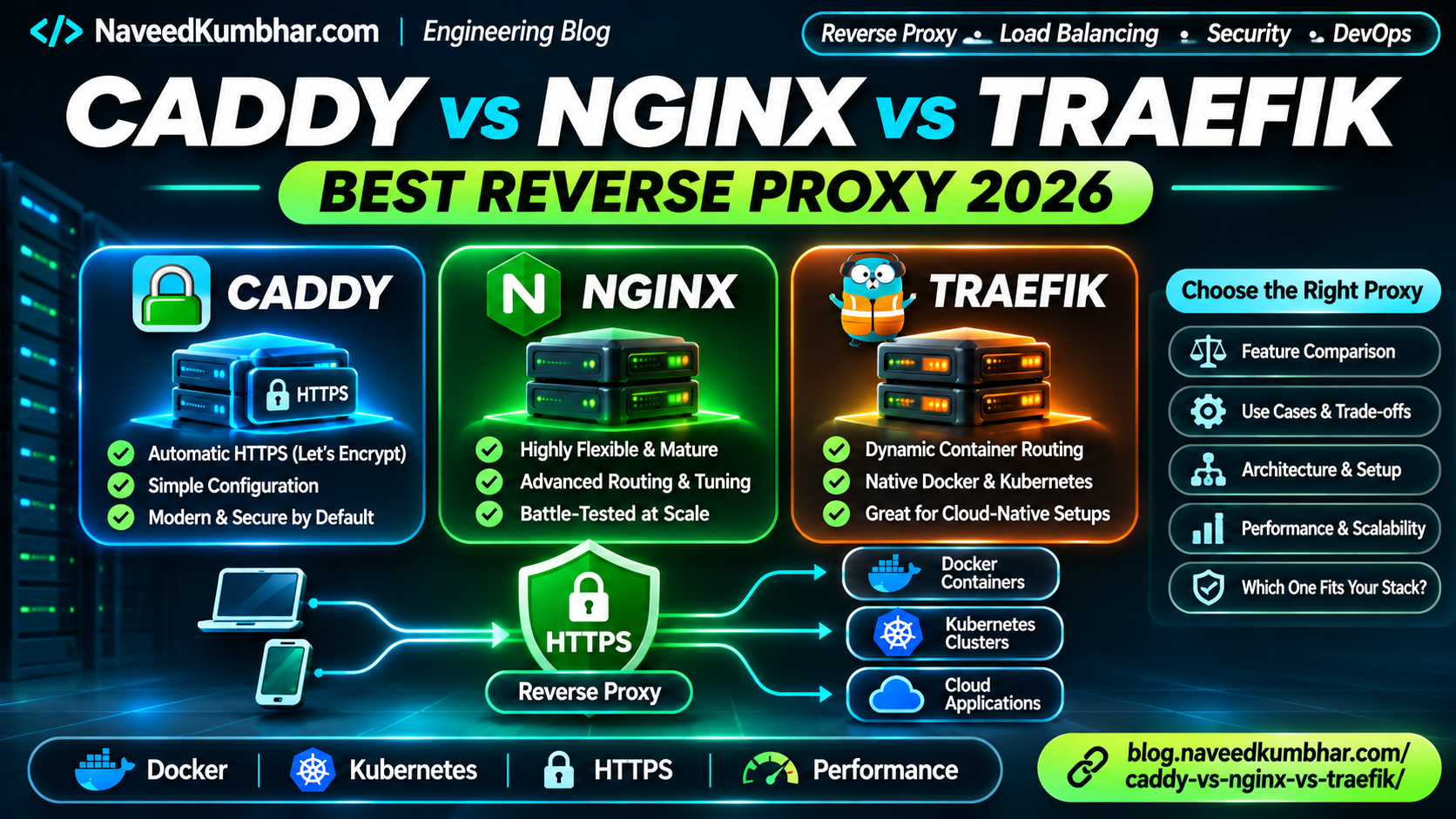
Three common options are Caddy, NGINX, and Traefik.
Caddy: Keep Configuration Simple
Caddy's biggest attraction is its straightforward configuration and built-in HTTPS automation.
For example:
api.example.com {
    reverse_proxy localhost:8080
}
For a valid public domain with the necessary DNS and connectivity, Caddy can manage TLS certificates automatically.
That can remove a significant amount of routine certificate maintenance.
NGINX: Control and Flexibility
NGINX offers mature reverse proxy capabilities, including request routing, buffering, caching, and upstream configuration.
It's a familiar choice for Linux servers and established application platforms.
But flexibility can mean more configuration to maintain, especially when services and certificates are managed separately.
Traefik: Dynamic Infrastructure
Traefik takes a provider-driven approach.
It can discover Docker services and build routes from container labels.
For Kubernetes, it supports Ingress, custom routing resources, and Gateway API integrations.
This approach is especially useful when workloads are frequently deployed or rescheduled.
Which Is Faster?
There's no universally correct winner for every workload.
Performance depends on protocol settings, backend applications, connection behavior, TLS, resource limits, and concurrency.
Benchmark the configuration you actually intend to operate.
A single synthetic requests-per-second result isn't enough to choose your production architecture.
Kubernetes Needs Special Attention
Kubernetes ingress implementations have different lifecycle and support models.
The community ingress-nginx project reached its announced retirement date in March 2026.
That is not the same as the NGINX web server or F5's NGINX Ingress Controller.
For new clusters and migration planning, evaluate maintained controllers and Gateway API support.
A Practical Decision Framework
Choose Caddy when ease of configuration and automatic HTTPS are major priorities.
Choose NGINX when you need mature routing controls or have established operational experience with it.
Choose Traefik when native service discovery is central to your Docker or Kubernetes environment.
Also compare your team's expertise, security posture, deployment process, and troubleshooting requirements.
Read the Full Guide
The original article compares reverse proxy architecture, HTTPS automation, configuration examples, memory and performance considerations, Kubernetes ingress, and production deployment choices.
Read Caddy vs NGINX vs Traefik: Complete Comparison
Which reverse proxy has been easiest for your team to operate in production?
Written by Naveed Ahmed — DevOps & Platform Engineering
About the author
- Senior DevOps, Cloud & Site Reliability Engineer at DigitalOcean. I write about modern container orchestration, Linux systems, and cloud-native architecture. Explore my guides, architectures, and portfolio: • Website: https://naveedkumbhar.com • Resume: https://cv.naveedkumbhar.com • Blog: https://blog.naveedkumbhar.com • Newsletter: https://news.naveedkumbhar.com
Comments
Join the discussionNo comments yet. Be the first to comment.