How to Use Jev AI for Typed Decisions in DevOps
Originally published on Naveed Ahmed's Engineering Blog.
Generative AI is excellent at producing explanations, summaries, and code.
But many software decisions are much narrower.
A monitoring application might need to classify an alert.
A CI/CD pipeline might need to flag a deployment for review.
An AI agent might need to choose which tool is appropriate for the next step.
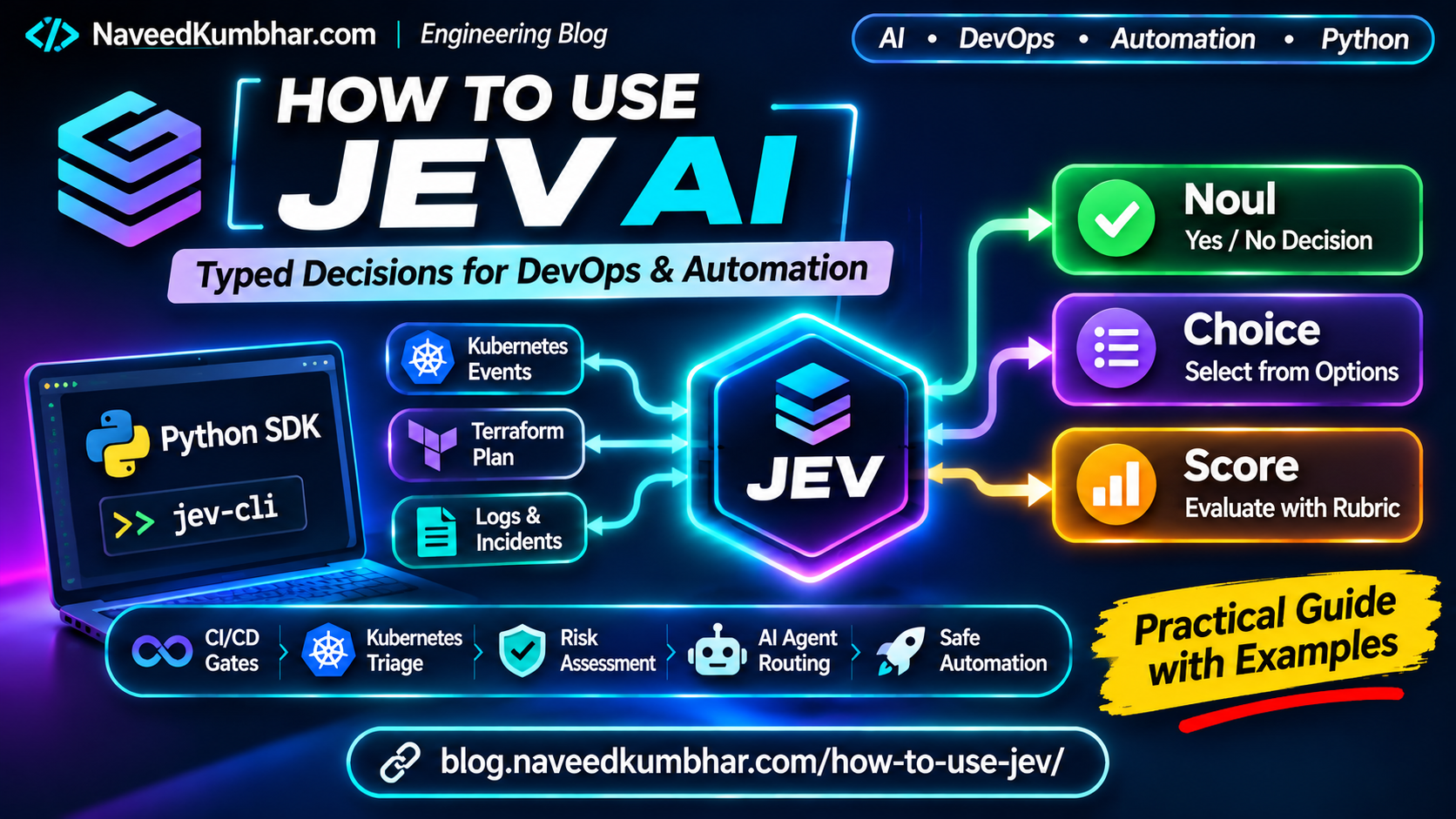
TypeSafe AI's Jev model is built around structured evaluations rather than open-ended prose generation.
Understanding Jev
You provide an input state and a set of typed questions.
Jev returns answers that software can process.
The three main primitives are:
Noul: Evaluate a yes/no statement.
Choice: Select from a known set of options.
Score: Evaluate an ordered rubric.
An experimental Box capability adds certain spatial and visual use cases.
Example: Kubernetes Incident Classification
Suppose a Pod repeatedly restarts.
Your incident system collects:
kubectl describe pod <pod-name> -n <namespace>
And:
kubectl logs <pod-name> \
  -n <namespace> \
  --previous --tail=100
After removing sensitive values, you can send relevant diagnostic text to a model for classification.
Possible categories include:
APPLICATION_ERROR
MEMORY_PRESSURE
DEPENDENCY_FAILURE
CONFIGURATION_ERROR
UNKNOWN
The model's output can help suggest which runbook or team to involve.
It should not be treated as a verified root cause without further investigation.
Python Integration
The official SDK can be installed with:
pip install typesafe-sdk
Keep your API key in a protected environment variable or a suitable secret manager.
Refer to the current SDK documentation for exact request builders and response access patterns.
CI/CD Use Cases
Jev can support advisory classification of:
- Pull request changes
- Deployment risk
- Terraform plans
- Canary telemetry
- Security escalation requirements
Use existing deterministic controls to enforce infrastructure policy.
Never let an AI model independently authorize destructive production actions merely because its confidence score exceeds a threshold.
Jev vs Generative LLMs
Jev is designed for narrower judgments that fit structured outputs.
Generative LLMs are more useful when a task requires detailed explanation, writing, code generation, or open-ended reasoning.
A practical agent architecture can use a decision model for routing and a generative model for the actual task.
Read the Complete Tutorial
The full article covers Jev's architecture, Python examples, Pydantic AI, command-line tools, and production DevOps guardrails.
Read How to Use Jev: Complete Guide
Would a typed decision model simplify any of your current automation workflows?
Written by Naveed Ahmed — DevOps & Platform Engineering
About the author
- Senior DevOps, Cloud & Site Reliability Engineer at DigitalOcean. I write about modern container orchestration, Linux systems, and cloud-native architecture. Explore my guides, architectures, and portfolio: • Website: https://naveedkumbhar.com • Resume: https://cv.naveedkumbhar.com • Blog: https://blog.naveedkumbhar.com • Newsletter: https://news.naveedkumbhar.com
Comments
Join the discussionNo comments yet. Be the first to comment.